
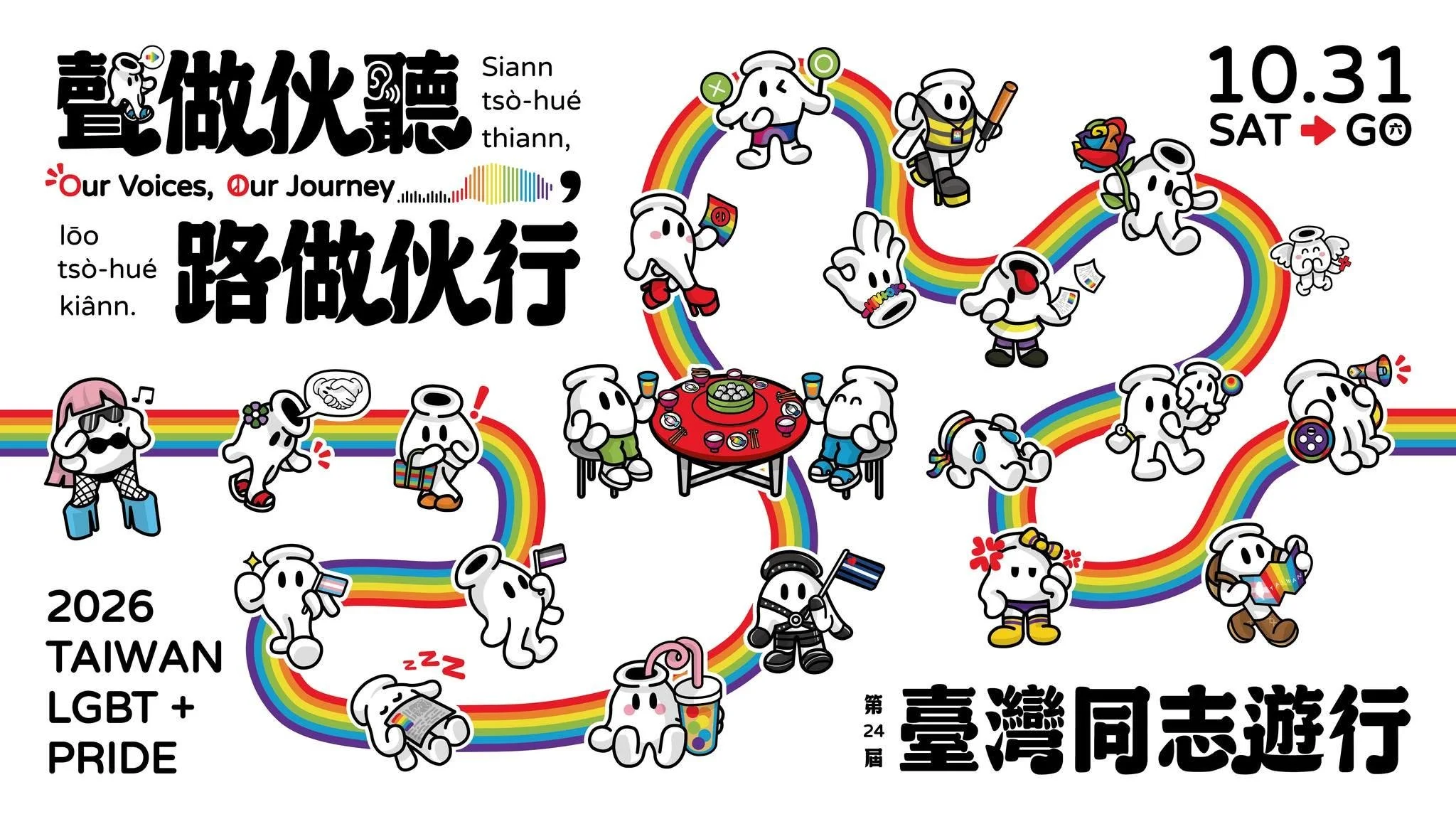
Our Voices, Our Journey
聲做伙聽 路做伙行 Siann tsò-hué thiann, lōo tsò-hué kiânn.
Taiwan LGBT+ Pride enters its 24th year, seven years after Taiwan legalized same-sex marriage. Looking at Taiwan's gender equality movement today, we find ourselves confronting intense conflict driven by political polarization. The international anti-DEI (Diversity, Equity, and Inclusion) backlash following Trump's election has coalesced into organized anti-LGBT+ forces, eroding hard-won gains in gender equality.
Across Asia, South Korea's Seoul Queer Culture Festival has been prevented from taking place at Seoul Plaza four times. When it was held at another venue in June 2026, an opposing demonstration took place just 700 meters away. Many young participants expressed their opposition through energetic singing and dancing; at first glance, their momentum appeared comparable to that of Pride supporters.¹ That same month, the Chinese gay dating app Blued was ordered by regulators to remove rainbow imagery and prohibit labels indicating identity or sexual roles, including “1,” “0,” and “side.”² Across both democratic and authoritarian states, opponents of LGBT+ rights continue to seek alliances with governments, while LGBT+ communities face state-level suppression.
The Executive Yuan's 2026 gender equality survey³ likewise reveals troubling shifts in public opinion. Agreement with the statement that “same-sex couples should have the legal right to marry” fell by 6.3 percentage points from the previous year. Attitudes toward transgender rights have also grown more conservative: support for changing one's legal gender marker without surgery⁴ dropped from 40.6% to 26.8%. Some studies further suggest that advances in marriage equality in Taiwan have not been accompanied by more positive media coverage of LGBT+ communities.⁵ The controversies surrounding Taiwan LGBT+ Pride 2025 are another reminder that LGBT+ rights in Taiwan could regress at any time.⁶ As the 2025 theme, “Beyond Links: More than Clicks,” sought to convey, polarization within online echo chambers deepens mutual misunderstanding, and we must look beyond labels to understand our differences. But how can we move beyond those labels? This year, we believe the answer begins with listening.
Only by Standing in Another's Place Can We Truly Hear One Another
In the story of the Tower of Babel,⁷ the fragmentation of language created barriers to communication and ultimately checked humanity's hubris. In society today, divisions of language, nation, class, gender, culture, and religion likewise make it difficult for us to grasp the lived realities of others. Over time, these divisions allow prejudice and fear to take root. Women's fear of sexual violence, for example, may make it difficult to empathize with transgender people's experiences of restroom access, further deepening misunderstanding and barriers to communication. Similarly, unfamiliarity with migrant workers among many people in Taiwan has given rise to many forms of discriminatory treatment.⁸ The same can be seen in the double standards with which Taichung police have treated LGBT+ social spaces.⁹ These examples show how difficult genuine listening and understanding can be across different communities.
As a society shaped by migration, Taiwan's multilingual everyday life presents both opportunities and challenges. People living on this land have shown openness toward different cultures, but that openness is becoming increasingly scarce amid the echo chambers created by social media. Learning to move beyond these echo chambers and genuinely listen to others has become an ability that people in Taiwan need to practise anew. Taiwan LGBT+ Pride has long provided an inclusive physical space for sexually and gender-diverse communities to engage as equals. For one day each year, members of these communities can walk the streets without fear and make their diverse voices heard throughout society. Yet this space for equality and expression cannot be taken for granted. At a time when DEI is in retreat internationally, many values are once again being put to the test. Sustaining such a space requires the continued support of people who share these values.
From the Feminist Rage Lights the Night March to Taiwan LGBT+ Pride, We Walk the Same Path
Taiwan LGBT+ Pride exists today because those before us built bridges and paved the way. Gender movements in a democratic society are built on the accumulated efforts of earlier generations; they must continually adjust their direction and broaden support in order to move forward. Thirty years ago, the “Feminist Rage Lights the Night March” affirmed that the pursuit of safety should not mean restricting the use of public space by any particular gender, but should instead confront the structural inequality beneath the issue. Participants also called for “Women want to walk safely at night, queers want to walk safely by day,” contributing to one of Taiwan's earliest LGBT+ street demonstrations. Taiwan LGBT+ Pride has been inseparable from gender equality from the beginning, and the pursuit of spaces in which people can live freely has remained a central thread in Taiwan's struggle for gender rights.
Taiwan LGBT+ Pride brings together people whose voices are isolated in society, giving those excluded by the mainstream the warmth and strength of community and allowing diverse voices to be heard on Taiwan's streets. It is also a practice of solidarity across marginalized communities, enabling sexually and gender-diverse communities to support and stand alongside other disadvantaged groups. People with disabilities, people living with HIV, Indigenous peoples, migrant workers, kink practitioners, and new immigrants have all taken the Taiwan LGBT+ Pride stage. We believe diversity is not a burden that holds progress back. In a democratic society, diversity teaches us to listen, build consensus, and move forward together with those who move at the slowest pace.
As a gender equality movement within a democratic society, Taiwan LGBT+ Pride depends on continual listening and dialogue. Through communication, minority perspectives can become part of a broader social consensus and contribute to social change. At the same time, we must recognize that the freedom to speak guaranteed by a democratic society cannot be taken for granted, and that democracy itself may face crises. Safeguarding a democratic way of life means safeguarding the soil in which diverse voices can grow; it is also essential to protecting gender equality. When people who speak different languages and live in different circumstances find common ground through listening and dialogue, the gender equality movement can move forward with steadier steps and a broader perspective. The continued practice of gender equality in a democratic society has become a source of resilience that enables Taiwan, within and beyond its borders, to resist patriarchy and authoritarian expansion.
In the face of the anti-DEI backlash, gender equality must advance or risk losing ground. At a global crossroads, Taiwan has forged a distinctive path toward gender equality.
Our voice, our journey. If you hear us, join us in the streets.
(The following supplement was added after the controversy surrounding the October 3 search of a gay venue by the Wanhua Precinct of the Taipei City Police Department.)
On October 3, 2026, excessive police action during a search of a gay BDSM-themed bar in Ximending by the Wanhua Precinct of the Taipei City Police Department¹⁰ reawakened the historical trauma of sexually and gender-diverse communities long subjected to oppression by state authorities. Looking back at Taiwan's gender equality movement, from the Changde Street Incident in 1997¹¹ and the AG Gym incident in 1998 to the Nongan Street Incident in 2004¹² and the Taichung gay venue incident in 2025, police intervention in and oppression of gay establishments and gathering places have left a wound that has never truly healed and is repeatedly reopened. Driven by unfamiliarity and voyeuristic curiosity, the public scrutinizes and severely stigmatizes gay people's sexuality and desires.
Without understanding the full picture or historical context, the media often seek attention through a sensationalist gaze and lurid headlines, leading the public to a distorted understanding of events and deepening divisions between communities.
Without understanding long-standing strategies for preventing sexually transmitted infections (STIs), police treat condoms as evidence in their investigations, turning a protective measure into incriminating evidence. Amplified by sensational media coverage, this not only deepens stigma but also creates a chilling effect, making STI prevention more difficult.
Unfamiliarity with people with disabilities led a police officer to ask, “He's disabled, and he can still have sex in there?” Yet the police claimed that they had “not verbally humiliated people with disabilities.” Society widely denies the sexuality of people with disabilities. An LGBT+ person with a disability may face two kinds of prejudice: “Your desires are abnormal” and “How could you have desires at all?” People with disabilities have the right to express desire and choose their relationships, as well as the right to say no and to receive accessible sexual health information and support. Yet these ideas, long promoted by advocates, remain unfamiliar to frontline law-enforcement officers.
Without understanding the importance of spaces for gay sexuality and desire or the trauma left by past incidents, society treats this as merely “a lawful search.” The pursuit of spaces in which sexually and gender-diverse communities can engage as equals and live freely has remained a central thread in Taiwan's gender equality movement. At this moment, sexually and gender-diverse communities no longer feel safe on Taipei's streets and constantly worry about improper police conduct. Oppression by state authorities once again highlights both the importance and the vulnerability of these spaces. Beyond physical spaces, discriminatory and malicious remarks have also appeared in online spaces and on social media. The polarization within online echo chambers addressed by the 2025 theme, “Beyond Links: More than Clicks,” has once again come to the fore.
Such unfamiliarity and misrepresentation ultimately lead to exclusion and oppression, subjecting sexually and gender-diverse communities to even more widespread stigma and discrimination. The discrimination exposed by this incident cannot be remedied by a few gender equality training sessions, nor is it merely a matter of individual officers' “inappropriate words and actions.” What we must confront is how difficult genuine listening and understanding can be across different communities in Taiwan today. After marriage equality reached an important milestone, those seen as wholesome, mainstream “good gays” gradually gained social acceptance. Yet beyond the “good sex”¹³ that society approves of, the sexuality of people with disabilities, people living with HIV, sex workers, people who use substances, Indigenous peoples, migrant workers, and kink practitioners is still treated as “bad sex.” These communities do not enjoy equal rights to express themselves freely and engage in sexual practices, and they are more vulnerable to oppression through state violence. For example, gay people who are shirtless in a bar may be seen as offending public morals, while members of the general public who are shirtless at the beach or a swimming pool are seen as healthy and natural. Condoms in spaces for gay sexuality and desire are treated as evidence of commercial sex, while condoms in hotels are seen as a sign of progress in modern attitudes toward contraception.
The voices calling for gender equality have not yet reached enough people; on the path toward gender equality, some face more obstacles than others. Yet even amid grief and a sense of injustice, we must not give up on listening. We must uphold our commitment to move forward together with those who move at the slowest pace. As it has in the past and will in the future, Taiwan LGBT+ Pride will continue to stand with what the majority considers “bad sex,” until society understands that all diverse sexual practices deserve respect.
Our Voices, Our Journey—listening together, walking together. We hope that, by listening together, everyone can hear the real needs of sexually and gender-diverse communities. Walking together means not only moving forward side by side, but also facing adversity, sharing burdens, and building a space where people of different genders and with diverse sexual desires and needs can coexist freely.
https://gec.ey.gov.tw/File/F060BC051DD56E07/9ad6e703-9dc2-4eea-aa78-ddf9de993c44?A=C
Percentage agreeing with the statement: “Transgender people should be able to change the sex shown on their identification documents without having their reproductive organs removed.”
Chen, J. H., & Lu, H. C. (2026). Evolving Landscapes, Shifting Narratives: Understanding Taiwanese News Media Portrayals of LGBTQ+ Populations from 2010 to 2021. Journal of Homosexuality, 1–29. https://doi.org/10.1080/00918369.2026.2690193
https://theinitium.com/20251024-whatsnew-taiwan-23rd-lgbt-pride-controversy/
For the story of the Tower of Babel, see Genesis 11:1–9. In the story, humanity attempts to build a tower reaching heaven in order to make a name for itself; God confuses their common language and scatters them across the earth. In contemporary humanities and social-science discourse, the story functions as a cultural symbol for the barriers to communication, hubris, loss of empathy, unavoidable prejudice, and social divisions that arise when groups are separated by language, culture, or lived experience.
Here, “unfamiliarity” and “discriminatory treatment” are often conceptualized in migration sociology as “boundary work.” Through psychological, spatial, and legal boundaries, Taiwanese society keeps migrant workers objectified and marginalized within the system, making equal communication across groups difficult. For a detailed discussion, see Lan Pei-chia, 《跨國灰姑娘:當代華人社會的幫傭、雇主與全球代間契約》 (Taipei: Qunxue, 2008). For exclusion and double standards toward migrant workers in everyday spaces—such as restrictions on sitting in Taipei Main Station's main hall and limits imposed on migrant-worker dormitories—see also the Taiwan International Workers' Association's advocacy reports on migrant workers' labor rights and social discrimination.
The reference to discrimination by Taichung law-enforcement authorities against an LGBT+ social space concerns the 2025 controversy over the Taichung City Police Department's Sixth Precinct raid on Body Fresh, an LGBT+ social venue in the Fengjia commercial district of Xitun. In January of the following year, police issued sensational publicity using phrases such as “male officers sacrificed their looks” and the pun “man upon man,” and disclosed investigative details in a way that shaped public opinion. Eight civil-society groups—including the Taiwan GDi Association, the Taiwan Tongzhi Hotline Association, and the Judicial Reform Foundation—jointly condemned the action, criticizing the lack of gender sensitivity, the violation of investigation confidentiality, and the institutional suppression and public shaming of sexually and gender-diverse communities' private spaces in the name of vague morality. See the Taiwan Tongzhi Hotline Association's 2026 public statement, 〈譴責臺中市政府警察局違反偵查不公開原則及欠缺多元性別敏感度〉, and the 2026 CivilMedia@TW press release, 〈抗議行政權淪為歧視工具:聲援 Body Fresh 生活會館〉.
https://zh.wikipedia.org/zh-tw/%E8%BE%B2%E5%AE%89%E8%A1%97%E4%BA%8B%E4%BB%B6
In 1984, Gayle Rubin proposed a framework for analysing sexual hierarchy. She identified twelve characteristics of sexual practices that society regards as good: marital, heterosexual, monogamous, vanilla, reproductive, non-commercial, coupled, relational, within the same generation, at home, without pornography, and involving bodies only. Their twelve counterparts—unmarried, homosexual, promiscuous, sadomasochistic, non-reproductive, commercial, alone or in groups, casual, cross-generational, in parks, involving pornography, and using objects—are regarded as bad. For a detailed discussion in Chinese, see https://www.coolloud.org.tw/node/85267